Navigating the next era of ecommerce starts with a clear signal. In Q1 2026, referral sessions from AI chatbots to Shopify stores grew more than eightfold year over year, while AI-attributed orders increased nearly thirteenfold. Shopify also reported a fifteenfold rise in AI-driven orders across 2025.
These figures are platform-specific, not universal benchmarks or an endorsement of one provider. However, the direction is increasingly difficult to ignore. AI is moving from an information layer to a commercial one.
Most marketing and ecommerce teams still think of this shift in terms of chatbots that answer questions before handing customers back to a traditional website and checkout.
Agentic commerce goes further. It describes systems in which AI can research products, compare options, evaluate constraints, make decisions, and initiate transactions on behalf of a user. The agent may become the interface, while product data, APIs, checkout systems, and policies operate behind it.
This changes how products are discovered, how brands are compared, and what ecommerce systems must make available to machines. It also introduces questions around control, authentication, pricing, and responsibility when automated purchasing goes wrong.
What Agentic Commerce Actually Means
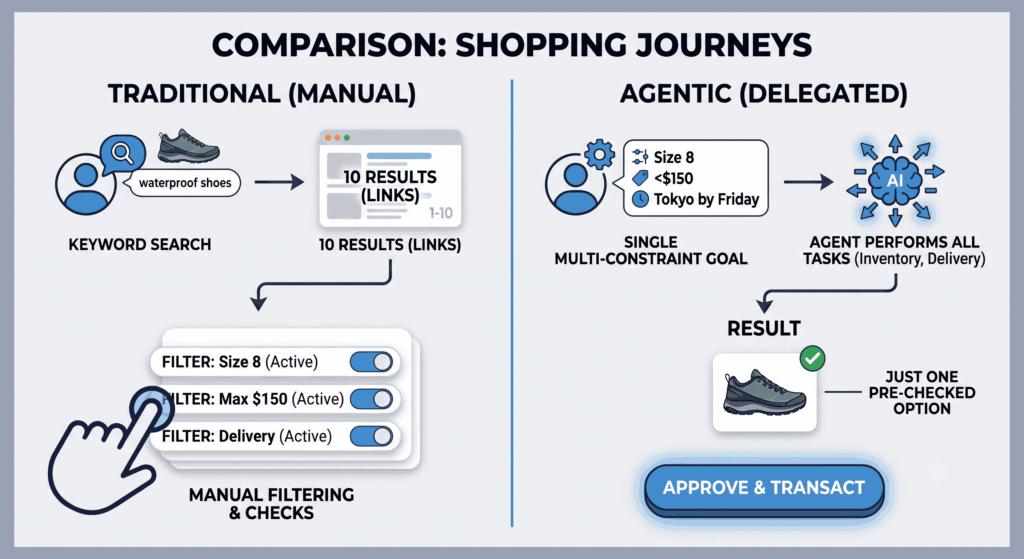
Agentic commerce describes shopping journeys in which an AI system can research, compare, decide, and transact toward a user-defined goal, rather than simply answer questions.
A conventional chatbot on an ecommerce website might respond to “Do you sell waterproof trail shoes?” by searching that retailer’s catalog and returning several options. An agent could instead be asked to find women’s waterproof trail shoes in size 8 for under $150, confirm delivery to Tokyo before Friday, compare return policies, and present the best option for approval before purchase.
The user sets the objective and constraints, but the agent handles much of the process. It may search multiple catalogs, check live inventory and delivery times, compare specifications, request approval, and place the order. This distinguishes agentic commerce from AI-assisted shopping, where the customer still drives each step.
Early versions are already emerging. ChatGPT supports product discovery and Instant Checkout through its Agentic Commerce Protocol. Perplexity offers product research and Instant Buy. Amazon’s shopping assistant can compare products and build carts, while Google is integrating AI-driven discovery with commerce and payment systems.
The platforms may change, but the direction is clear: customers will increasingly delegate parts of the shopping journey to AI agents. Ecommerce sites must therefore work for both people and machines.
How Discovery and Search Are Changing
AI search is changing how people find and compare products. Instead of simply showing links, tools such as Google’s AI summaries can present information directly in the search results. Pew Research Center found that users clicked a traditional result in 8% of visits when an AI summary appeared, compared with 15% when it did not.
This means more research may happen before a customer reaches a website. Shoppers can ask AI to compare prices, reviews, specifications, and delivery options, then arrive at a product page with a clearer idea of what they want.
Shopify’s Q1 2026 data points in the same direction. More than half of AI-referred visits began on product pages, compared with about 20% of organic-search visits. These sessions also converted nearly 50% better and produced average order values 14% higher.
For marketers, rankings still matter, but they are no longer enough. Product information must also be clear and easy for AI systems to interpret. Structured data, accurate feeds, consistent metadata, and strong trust signals are becoming part of modern SEO.
Our guide to monitoring, ethics, and future-proofing an AI discoverability strategy explains how businesses can manage this shift over time.
The Technical Foundation: Making a Site Machine-Readable
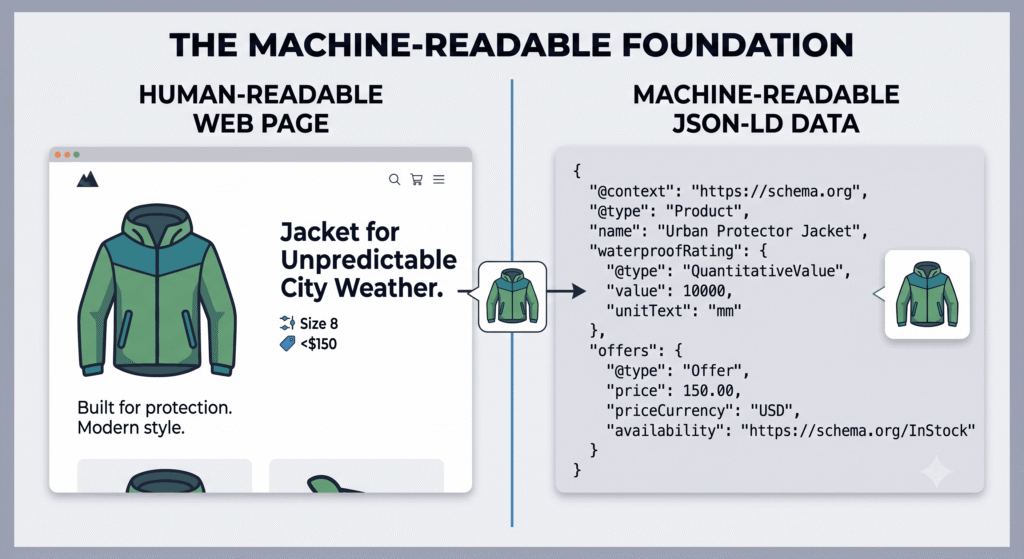
Agentic commerce depends on whether software can reliably interpret what a business sells, under what conditions, and through which systems a transaction can be completed. Machine-readable content, structured data, semantic HTML, product information, accessibility, and APIs form one connected technical foundation.
Machine-Readable Content
Machine-readable content is structured so software can identify and extract it without relying heavily on inference. A human may understand that a jacket described as “built for unpredictable city weather” is water-resistant. An agent should not have to guess. The product record should state its material, waterproof rating, sizes, price, availability, shipping restrictions, and return conditions.
Brand storytelling still matters, but the factual layer must be explicit and consistent beneath it. For international brands, that consistency must survive localization. Specifications, inventory, delivery conditions, and return rules should remain aligned across English and Japanese versions, even when the surrounding copy is adapted.
For more background, see How Generative AI Finds and Uses Your Content.
Structured Data and Schema
Structured data adds standardized labels to website content so machines can understand it more reliably. Using the shared vocabulary provided by Schema.org, often through JSON-LD, an ecommerce site can clearly identify details such as a product’s name, brand, SKU, price, availability, variants, ratings, shipping terms, and return policies.
Search engines already use this information to interpret product listings, and the same clarity helps AI systems compare products and answer commercial questions. However, structured data is only as reliable as the information behind it. If product pages, feeds, and inventory systems contain conflicting details, markup will expose the inconsistency rather than solve it.
Ecommerce APIs
An API allows one system to request information or perform an action in another. In ecommerce, APIs can provide access to product catalogs, prices, inventory, carts, shipping calculations, payments, orders, and returns.
Without this direct connection, an AI agent may need to extract information from a rendered page, which is less dependable when stock, pricing, and delivery options change frequently. With an appropriate API, an authorized agent can check whether a variant is available, calculate the delivered price, confirm an arrival date, or verify that pricing has not changed since the customer approved the purchase. The information comes directly from the system of record, making it more current and reliable.
Semantic HTML
Semantic HTML uses page elements according to their purpose. A heading is marked as a heading, and an interactive control is coded as a real button.
Instead of:
<div class=”buy” onclick=”addToCart()”>Buy now</div>
A semantic version uses:
<button type=”button”>Add to cart</button>
The two controls may look identical, but the second communicates its function more clearly to browsers, assistive technologies, crawlers, and automated systems.
The W3C recommends semantic markup because it makes page structure and relationships explicit.
See Making Your Content AI-Friendly: Technical and Structural Strategies for a broader technical overview.
Product Information Quality
AI agents cannot recommend products reliably when key details are missing or unclear. Product data should therefore include practical information such as dimensions, materials, compatibility, warranties, shipping limits, and return terms. Specific facts are far more useful than vague claims such as “premium quality.”
Accessibility as Infrastructure
Accessibility also makes websites easier for machines to understand. Clear headings, descriptive links, labels, alternative text, and accessible controls help expose the structure and purpose of a page.
AI agents and screen readers work differently, but both benefit when information and actions are communicated clearly rather than through visual design alone.
Headless and Composable Architecture
Headless commerce separates the customer-facing website from backend systems, with APIs connecting them. Composable architecture allows individual services to be updated or replaced without rebuilding the entire platform.
This can help businesses keep product data and transactions consistent across websites, apps, marketplaces, and AI tools. However, it also adds cost and complexity, so it should be adopted only when the business need is clear.
Completing the Transaction: The Agentic Checkout Layer
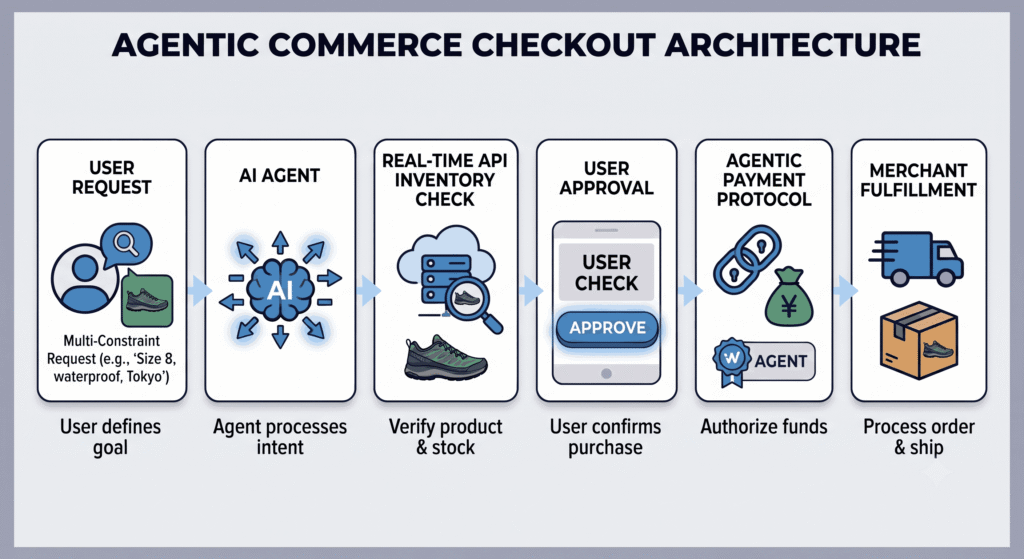
Finding and understanding a product is only part of agentic commerce. An agent also needs a secure, controlled way to place the order.
Emerging systems include OpenAI’s Agentic Commerce Protocol, Google’s Agent Payments Protocol, Visa Intelligent Commerce, and Mastercard Agent Pay. Although they work differently, they address the same basic questions: Which agent is acting? Did the customer approve the purchase? What spending limits apply? Have the price or stock levels changed? Can the transaction be reviewed or reversed?
A checkout-ready system therefore needs accurate totals, tax and shipping calculations, live inventory checks, secure authentication, payment approval, order tracking, and clear cancellation and dispute processes.
Most systems still require customer approval at key stages. Fully autonomous purchasing across different merchants, payment networks, and legal jurisdictions remains unresolved.
Risks and Open Questions
Agentic commerce introduces new efficiencies, but it also shifts or weakens familiar control points for brands. These risks are not reasons to delay preparation, but they do require stronger governance and more robust technical foundations.
Brand and Pricing Control
Challenge: When an agent summarizes a product, the brand loses control over presentation. Visual identity, editorial framing, and positioning may be reduced to a small set of comparable attributes such as price, availability, delivery, and reviews.
Response: Strengthen the underlying product data that agents rely on. Clear attributes, consistent policies, and verifiable claims help preserve differentiation when brand storytelling is compressed.
Machine-Speed Comparison
Challenge: Agents can compare products, prices, and delivery options across merchants much faster than human customers. This increases transparency but also exposes inconsistencies across markets, channels, bundles, and promotions.
Response: Treat product feeds, pricing logic, promotions, and stock rules as governed systems rather than static content. Consistency and control over what unauthenticated systems can access become operational priorities.
Responsibility and Errors
Challenge: Agents may misinterpret instructions, select incorrect variants, or act on outdated information. Responsibility can become distributed across customers, merchants, AI providers, and payment systems.
Response: Ensure clear audit trails for approvals and transactions, supported by robust cancellation, return, dispute, and escalation processes. These mechanisms won’t eliminate ambiguity, but they make issues traceable and resolvable.
Practical Steps Businesses Can Take Today
Preparing for agentic commerce does not require an immediate platform rebuild. Many of the most useful steps also improve SEO, accessibility, operations, and customer experience.
Now
- Audit structured data across products, variants, availability, shipping, and returns.
- Compare product pages, feeds, and backend systems for inconsistencies.
- Review analytics, referrers, server logs, and recognized AI user-agent patterns.
- Identify and fix important information that exists only as unstructured copy.
Next
- Improve semantic HTML and accessible interface controls.
- Complete missing product attributes and remove contradictory descriptions.
- Strengthen accessibility across navigation, forms, images, and checkout.
- Document APIs for catalog, inventory, pricing, shipping, orders, and returns.
- Establish governance for English and Japanese product information.
Later
- Assess whether the architecture can support AI and conversational interfaces without duplicating data and logic.
- Consider headless or composable systems where channel complexity justifies them.
- Test agentic checkout in controlled use cases.
- Define rules for authentication, consent, spending limits, logging, disputes, and human escalation.
The immediate goal is not to predict which protocol will dominate. It is to ensure the business has accurate information, accessible interfaces, reliable APIs, and enough flexibility to connect to relevant channels as they develop.
Preparing for a Machine-Mediated Customer Journey
Agentic commerce is still developing. Standards are competing, availability varies between markets, and businesses are still deciding how much control to give AI systems operating between brands and customers. However, the overall direction is consistent. AI is already influencing research, comparison, referrals, carts, and checkout. The growth figures reported by commerce platforms should be treated as an early industry signal, not proof that every business needs every new integration.
The practical response is to strengthen the foundations of digital commerce: structured product information, accessible interfaces, semantic content, reliable APIs, and flexible architecture. Businesses that improve these areas will be better prepared whether the next customer arrives through Google, ChatGPT, an independent shopping agent, or an interface that has not yet launched.
Netwise helps international and Japan-focused businesses get the most out of their internet-connected systems.. To explore how your website or e-commerce store can become more machine-readable and ready for the next phase of digital commerce, contact us.